Going First: Commercial Autonomous Flight in New Zealand in 2027
UpdateJune 10, 2026


Matt George, Founder and CEO, Merlin Labs
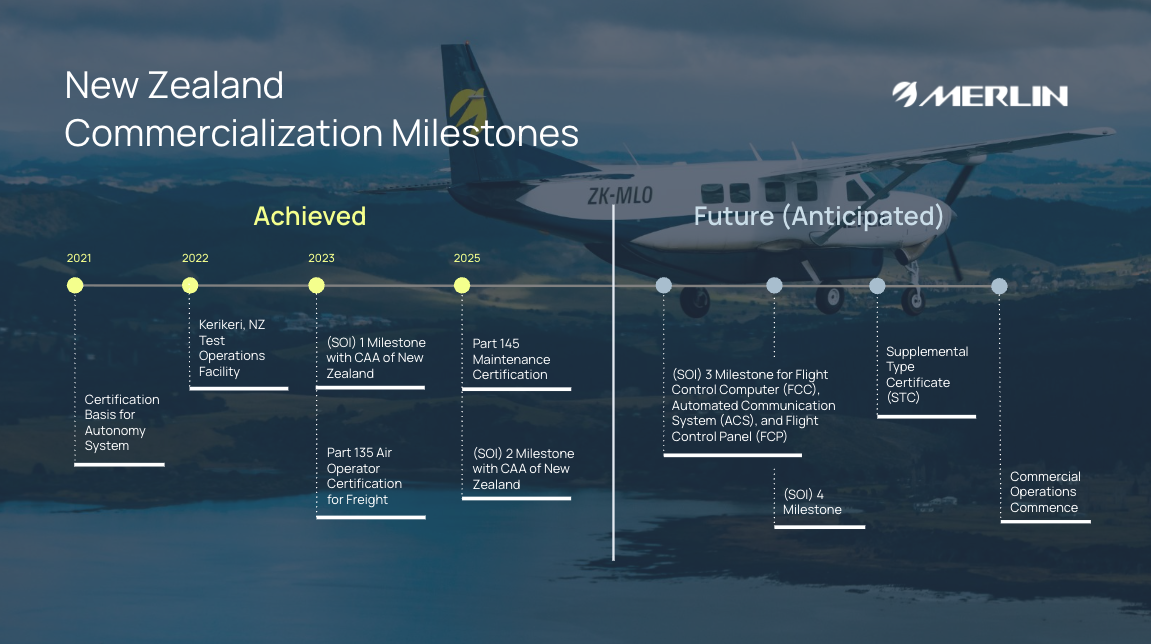
Today I want to share more about our plan to commercialize autonomy and our path to certification, in New Zealand and the United States. In the history of aviation, no traditionally crewed, fixed-wing aircraft has flown autonomously in commercial revenue service. Our goal is for Merlin to be the first to do it, and we are working to get there in 2027 from our test facility in Kerikeri, New Zealand. By commercial service, I mean real autonomy on real aircraft, flying real routes, in revenue-generating operations.
We picked New Zealand as a key part of our test operations because it gives us a unique environment to build autonomy that holds up in the most challenging conditions. Since 2022 we have operated a flight test and development center in the far north of the country. New Zealand's maritime domain is roughly the size of the continental United States. It has some of the most isolated communities in the world, diverse terrain, and rapidly changing weather. Aviation in New Zealand is essential infrastructure that connects people, businesses, and communities. The Civil Aviation Authority of New Zealand has engaged seriously with us and held us to a high standard, and that is the environment we want.
To date we have logged hundreds of autonomous test flights using the Merlin Pilot, the same AI-powered autonomy system we are working to certify with the Civil Aviation Authority of New Zealand and on a concurrent validation pathway with the U.S. Federal Aviation Administration. We believe we have passed meaningful markers on the certification path this year and are approaching its final phases. We are designing the system to fly, from takeoff to touchdown, under the same regulatory oversight as any other aircraft in the airspace.
As we noted on our most recent earnings call, the Merlin Pilot is designed to become a multi-application, multi-airframe platform. This means that we are pursuing different use cases for the technology simultaneously. In this context, the commercial milestone we are pursuing in New Zealand is an important complement to our defense work. No one has done this, because it is very hard. Building the technology is hard, and getting it certified is even harder. We believe this is what the future of aviation looks like, and we are focused on getting there. We believe that flying real commercial routes with the Merlin Pilot is proof of our thesis: autonomy built from first principles, shaped by certification requirements from day one, and validated in real operational environments can produce a system regulators can certify, operators can deploy, and communities can rely on.
Matt George
Founder and CEO, Merlin Labs
Forward-Looking Statements
This post contains forward-looking statements within the meaning of the Private Securities Litigation Reform Act of 1995. All statements other than statements of historical fact should be considered forward-looking statements, including without limitation statements regarding the timing and likelihood of future Merlin Pilot commercial flights and operations in New Zealand, Merlin's expectation of being the first to operate a traditionally crewed, fixed-wing aircraft autonomously in commercial revenue service, the initial commercial application of the system, and anticipated regulatory certifications and approvals with the Civil Aviation Authority of New Zealand and the Federal Aviation Administration. These forward-looking statements are based largely on our current expectations and projections about future events and trends. These forward-looking statements are neither promises nor guarantees, but involve known and unknown risks and uncertainties that could cause actual results to differ materially from any future results, performance or achievements expressed or implied by the forward-looking statements, including without limitation the risks, uncertainties, and assumptions described under "Risk Factors" in Merlin's Prospectus filed with the SEC on March 13, 2026, and its Quarterly Report on Form 10-Q filed March 15, 2-26. Except as required by applicable law, we undertake no obligation to update any of these forward-looking statements for any reason after the date of this post.
Related


Merlin Expands East Coast Presence with New Flight Test Operations at Quonset State Airport
Update
May 01, 2025


A Letter to Shareholders from Matt George, Founder and CEO of Merlin Labs Fellow Shareholders
Investor
Feb 19, 2026


2025: The Year of AI-Driven Aviation Innovation and Collaboration
Update
Jan 09, 2025