Presence Is Deterrence: Autonomy for the World’s Unwatched Waters
UpdateOctober 06, 2026


Palau: A Nation of Eighteen Thousand, a Maritime Domain the Size of Texas
The Republic of Palau is a nation of roughly 18,000 people scattered across an archipelago in the western Pacific. Its Exclusive Economic Zone, the ocean territory it is responsible for monitoring and protecting, is comparable in size to the state of Texas. That expanse can hide illegal, unreported, and unregulated fishing fleets stripping the waters Palauan communities have depended on for three thousand years.
The United States holds primary responsibility for Palau's security under the Compact of Free Association. U.S. Indo-Pacific Command has identified a need for expanded ISR platforms capable of providing persistent coverage across the region’s vast distances. This vastness in Palau presents a surveillance challenge that no small nation can reasonably address alone with a conventional ISR enterprise. Retaining the specialized personnel needed to operate it is inherently difficult and expensive. Some donated assets have therefore been challenging to use consistently, particularly when assistance programs provide short funding horizons or limited plans for long-term sustainment. At the same time, American funding mechanisms, while designed to promote responsible investment, often require partners to demonstrate five years of sustainment.



President Whipps in Merlin’s Hangar
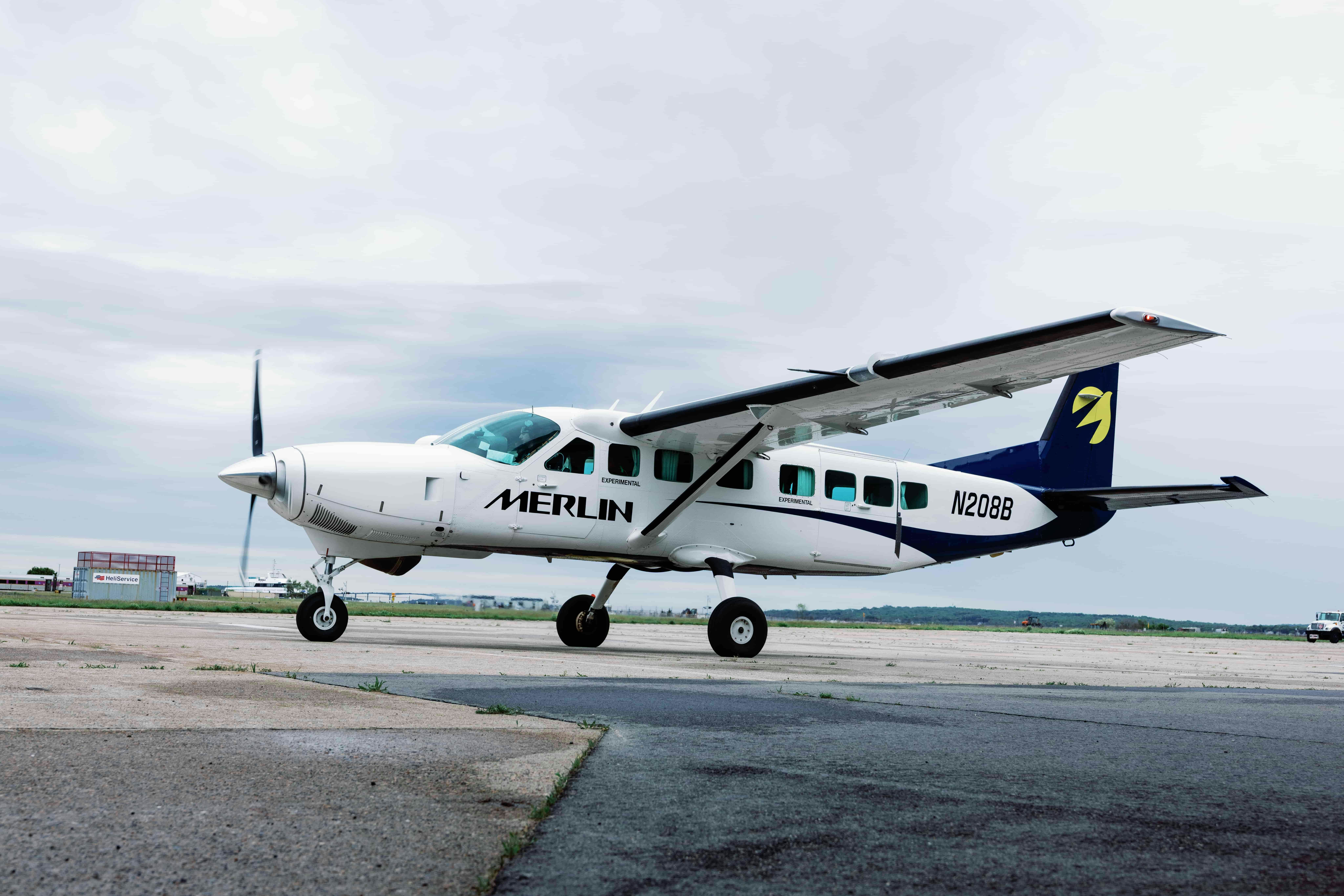
This year, we hosted President Surangel Whipps Jr. and Ambassador Hersey Kyota at our test flight facility in Rhode Island. The President of Palau stood in our hangar, watched our technology fly, and told us he wants his nation to be a test case for autonomous aviation in the Pacific for surveillance of its waters and for cargo delivery to outer islands that today depend on a two-aircraft missionary air service.
Think about what Palau is actually asking for. Not a $30 million aircraft. Not a program that requires a training pipeline it cannot easily staff. Not another system that arrives with a ribbon-cutting and dies with a budget cycle. Palau is asking for persistent, affordable surveillance and cargo delivery capacity, that requires minimal local manpower, and is sustainable beyond any single political window.
That is not simply a procurement specification. It is a description of what autonomous ISR is designed to deliver, and is consistent with current Department of War priorities, including the persistent focus on protecting the homeland even outside its borders. ISR crews are experienced and exceptionally well suited to the mission, however, their resources are limited making the constraint crew availability and cost. Every crewed sortie requires at least a pilot and dedicated sensor operator, and assigning that team to one area inevitably leaves another uncovered. As the threat environment expands, those tradeoffs multiply. Autonomy could help close that coverage gap by extending persistent, affordable surveillance across more territory without requiring a corresponding increase in aircraft crews.
Palau Is Not the Edge Case. Palau Is the General Case.
The Pacific is a decisive theater of this century, and it is a theater defined by the tyranny of distance: vast ocean, scattered islands, sparse basing, and partner nations whose strategic importance often exceeds their capacity to field conventional forces. Palau’s challenge is shared across the region, from the Philippines monitoring the West Philippine Sea to Papua New Guinea, Fiji and the Federated States of Micronesia. Even well resourced allies such as Australia, Japan, and New Zealand cannot generate enough crewed ISR sorties to monitor the immense waters for which they are responsible, and the U.S. Navy and Coast Guard cannot cover it for them. The conventional answer of more exquisite platforms, more crews, more bases is not sufficient.
Autonomy could offer a new, more successful way to achieve the mission. It could be deployed on aircraft that partner nations already operate or can acquire affordably, while software-based capabilities continue to improve over the life of the program rather than becoming obsolete. We believe operating costs will be significantly less than the crewed alternative, and within reach of an island nation, or fit within the smaller, faster funding channels most likely to deliver support. The result is a model that could give partner nations an enduring capability.
Cautionary Statement Regarding Forward-Looking Statements
This post contains forward-looking statements within the meaning of the Private Securities Litigation Reform Act of 1995; actual results may differ materially from those anticipated, and readers are cautioned not to place undue reliance on such statements, which speak only as of the date of this post and are subject to the risks and uncertainties described under "Risk Factors" in our filings with the Securities and Exchange Commission, including our Prospectus dated May 13, 2026, filed with the SEC on May 13, 2026, and our subsequently filed Quarterly Reports on Form 10-Q, which are available from the SEC. Except as required by applicable law, we undertake no obligation to update any of these forward-looking statements after the date of this post.
Related


Merlin Adds L-39 Albatros to Its Test Fleet, Helping Merlin Pilot™ Extend to More Tactical Mission Sets
Update
Oct 15, 2026


Merlin’s Recommendations for the OSTP AI Action Plan
Update
Mar 20, 2025


Merlin, Inc. Announces $80 Million PIPE Investment to Accelerate Program Execution and Unlock New Growth Opportunities
Press Release
Apr 29, 2026