Air Power is Scaling Faster Than Pilots
UpdatesJune 22, 2026


Tim Burns, CTO, Merlin
Remarks from the RAeS Future Air and Space Defense Summit
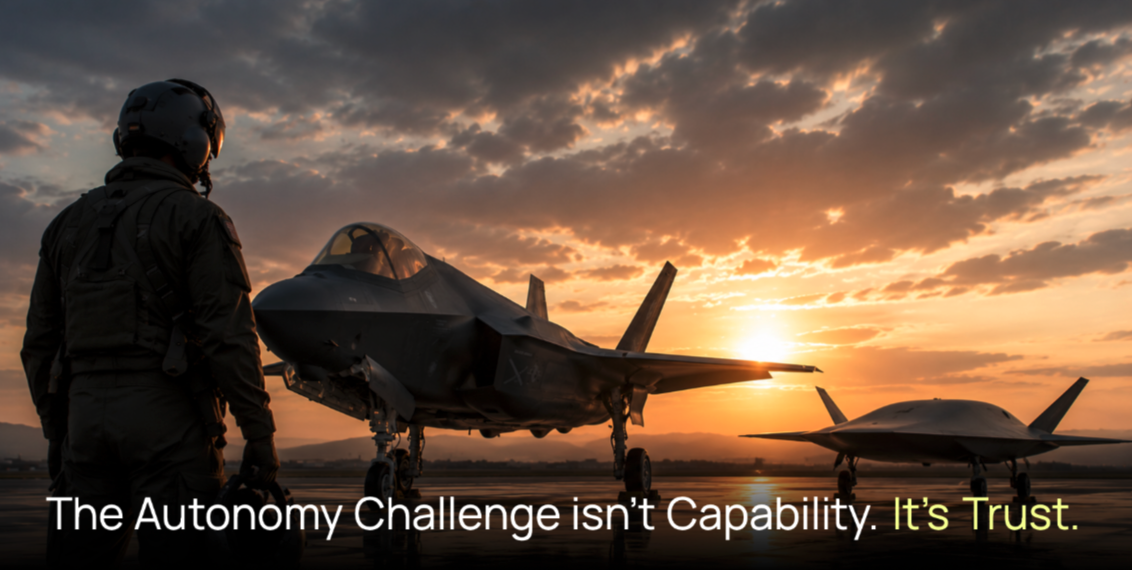
There's a tendency, when talking about AI and autonomy in defense, to make it a conversation about capability. What can the system do? How fast? How accurately? Can it beat a human in a simulated engagement? These are reasonable questions. But I'd argue they're the wrong starting point.
Last month, I had the privilege of joining the Emerging Technologies for Strategic Advantage panel at the Royal Aeronautical Society's Future Air and Space Defense Summit, alongside Air Vice-Marshal Mark Ridgway from ACDS Futures and Force Design, and George Land of Hybrid Air Vehicles, with Air Marshal Sir Christopher Harper keeping us honest from the chair. The conversation ranged across AI, autonomous systems, quantum technologies, and space-based innovation. What struck me most wasn't any disagreement about the technology, but the shared recognition of how fast operational demand is outpacing our current structures.
The future battlespace requires persistent Intelligence, Surveillance, and Reconnaissance (ISR), distributed operations, and attritable systems at scale. Mission demand is growing geometrically. The pipeline for trained military aviators is not. And, the industry more broadly is facing a pilot shortage with the U.S. needing more than 120,000 new pilots over the next 20 years. Human pilots are extraordinary but they don't scale at the same rate as the threat. That's not a criticism of the people, it's a description of the problem.
So the question our panel kept returning to wasn’t capability, it was speed. How quickly can we actually scale and integrate these technologies in a way that's operationally credible, trusted by commanders, and accepted by allies?
At Merlin, the framing we keep coming back to is Artificial Airmanship.
Aviation has never fundamentally been about machines. It has always been about disciplined decision-making under uncertainty. Great aviators make trade-offs constantly, whether it’s risk versus mission success, fuel versus weather, survivability versus effectiveness. Autonomy needs to inherit both that judgment as well as the mechanical execution.
This is why autonomous systems in aviation cannot simply behave as unconstrained AI. That's not operationally credible and certainly not certifiable. Assured autonomy means learning how experienced pilots actually think, bounding and assuring system behavior, and maintaining human accountability throughout. Autonomy can reduce workload and extend mission reach, allowing humans to remain accountable for life-impacting decisions. That distinction is the foundation on which operational trust is built.
The panel also framed defense innovation as an engine for economic growth. While that’s true, economic value follows operational credibility, not the other way around.
Trust is the hard part. Technological capabilities are advancing faster than most people outside this industry realize. But these technologies alone don't lead to allied interoperability or regulatory acceptance. In aviation, trust is earned through engineering discipline, certification, and operational experience accumulated over time.
Getting that right means autonomy becomes scalable, operational infrastructure for the future of air power.
That's the prize, and it's worth being rigorous about how we get there.
The views expressed in this post reflect the personal perspectives of Tim Burns, Merlin's Chief Technology Officer, and contain forward-looking statements within the meaning of the Private Securities Litigation Reform Act of 1995; actual results may differ materially from those anticipated, and readers are cautioned not to place undue reliance on such statements, which speak only as of the date of this post and are subject to the risks and uncertainties described under "Risk Factors" in our filings with the Securities and Exchange Commission, including our Prospectus dated May 13, 2026 and our Quarterly Report on Form 10-Q filed May 15, 2026.